
APMP ANZ Bid-Winning Conference 2026: Takeaways on Human Insight, Technology, and the Future of Proposals
Written by Oliver Tomlinson, Information designer and agency founder
The last APMP conference I attended was all the way back in 2014, when TDL-CREATIVE had a stand, branded stationery, and a guide on printed bids (remember those days?), and I had fewer grey hairs – how times have changed! Back then, it was an opportunity to be part of a bid community. Now, 12 years later, I’ve returned, but this time on the other side of the globe.
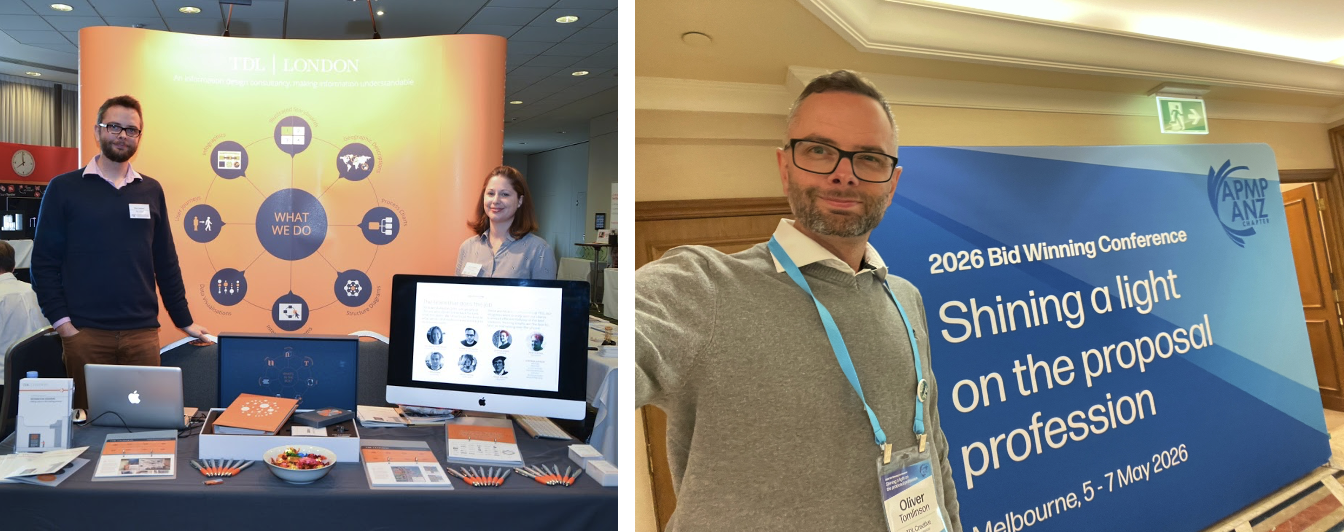
APMP past and present: My wife and I with our TDL exhibitor stand at the UK APMP conference in 2014, and me (still wearing a shirt and jumper combo!) 12 years later at APMP ANZ in Melbourne
From the pages of notes I took at the APMP ANZ Chapter bid-winning conference in Melbourne, 5 - 7 May 2026 (note the omission of ‘th’ in the date – I’m getting to know Australian nuances now!), I have distilled my thoughts into three key areas: 1) AI in Bids, 2) Proposal Humans, and 3) The Future Outlook.
PLEASE NOTE: This is a personal account of my visit to the APMP Conference, with quotes reflected from my own notes. Presenter names have been noted when referred to.
AI in Bids
Yes, I know you are probably bored to death of seeing AI this and AI that all over the place at the moment, and this conference was no different, but we MUST engage with it to understand the positives and negatives. The one thing I can say for sure, is nobody really knows where it’s going, and I’d say there are more uncertain and worried people than there are excited AI advocates.
From the buyer’s perspective
It was great to see a panel discussion from the perspective of the buyers (including Dan Fielding FCIPS a procurement consultant, and Thomai Veginis from V/Line), especially for me as an information designer, where customer-centric design is so important. Working from the bid team side of the fence, we often hear about the client ‘not knowing what they want’, ‘not having the data’, or ‘not providing enough time’, so it was fascinating to empathise with the procurement teams to understand what they need.
With the impact of COVID and the focus on supply, procurement is now at the ‘top table’ and the forefront of business activity. Currently, there’s a big push to de-risk supply chains by buying local rather than relying on global, even if there’s a higher cost involved. Essentially, supply certainty is overruling the price.
There was an interesting question from the audience on Environmental, Social and Governance (ESG) requirements in tenders, and if they actually made a difference, or were just a box-ticking exercise. The answer was yes, they can impact the bid scoring, but it does depend how mature the procurement function is. Do your research to find out how important ESG is to the client you are bidding to, starting with their website and social media presence.
On the question of AI, it is, of course, being utilised client-side too. Request for Proposal (RFP) documents are being built in it, respondents are using it in their bids, and evaluators are using it to mark the content. This was also mentioned in Charmaine Keegan’s talk when she pointed out that AI isn’t just for bid teams, it’s for procurement teams and evaluators too, and we must remember that our clients are more ‘educated’ about us than ever before.
"Our clients are more educated about us than ever before" Charmaine Keegan, Smarter Selling
Back to our panel, they did mention a warning that “there is a risk that procurement can become LAZY”. This was the second time in two weeks I’ve heard the term ‘lazy’ associated with using AI, and I think it contradicts the advocates for it. People are saying it’s there to help us with the churn and research tasks, so we can focus on ‘deep thinking’ and clever stuff, but I think we might be underestimating how lazy humans actually are! We are masters of efficiency, so if we get a choice to think hard or think easily, we are more likely to go the easy route. Will we proactively think hard or just allow AI to tick over while we enjoy some leisure time instead?! Interestingly, we had a presentation from Ken Grace (‘Thinking Straight – if it’s such a good idea, how come nobody does it?’) on how we make decisions, which links to this theory. Ken said we need to avoid making decisions from small (easy) patterns in results, and we are often very confident when we are wrong! He also made the point that having more than one win theme may not make sense, but I’ll reserve judgement until I’ve read his recommended book (listed at the end).
The procurement panel admitted there can be personal bias when marking proposals, but good procurement will aim to remove this bias, e.g. by using blind tenders, and pointed out it might not actually be the procurement team evaluating the response. The personal element of bidding can make things tricky when all the tenderers hit the criteria, and it comes down to relationships, but the panel were careful to highlight the tricky balance between ‘relationships’ and the Government’s ‘paranoia’ of conflicts of interest. Bidding into the private sector might allow more opportunity to collaborate, form relationships and design an innovative contract – therefore differentiating you from the competition.
From the bidder’s perspective
A panel session including Kate Woodlock from EY and Cynthia K. from UGL discussed the use of AI in proposals, with Kate kicking it off by saying EY have AI agents currently fully automating the sales process. However, EY have identified which steps need to be a ‘human’ experience, i.e certain touch points where face-to-face interactions are required. But to me, this feels like the technology is the overarching feature rather than the support. Are the humans supporting the tech, or the tech supporting the humans?
“You put garbage in, you get garbage out” Cynthia Krishna, UGL
Cynthia warned us that “you put garbage in, you get garbage out”, and that AI will quickly scale rubbish responses. At UGL they only use AI to get a question to bronze, making the SMEs (subject matter experts) accountable for using it in their response. If anyone attended Chris Vincent's talk on ‘Effective strategies to extract content from SMEs’, you might be a little worried about whether the SMEs will be double-checking the AI content, especially considering my thoughts on built-in human laziness. But I can certainly see how the early stages of getting something on the page can really help people formulate a response; it’s easier to ask “what’s wrong with this?” rather than “write two pages on…”.
Kate described the bid document as being an ‘artefact’, with AI getting the document development done quickly, so time can be better spent on other stages, such as moving technical experts at the front end of the sales process or upskilling people in presentations to deliver an ‘event’. Charmaine Keegan might raise a few concerns in using the technical people at the front end of the process, though (see ‘Proposal Humans’ below).
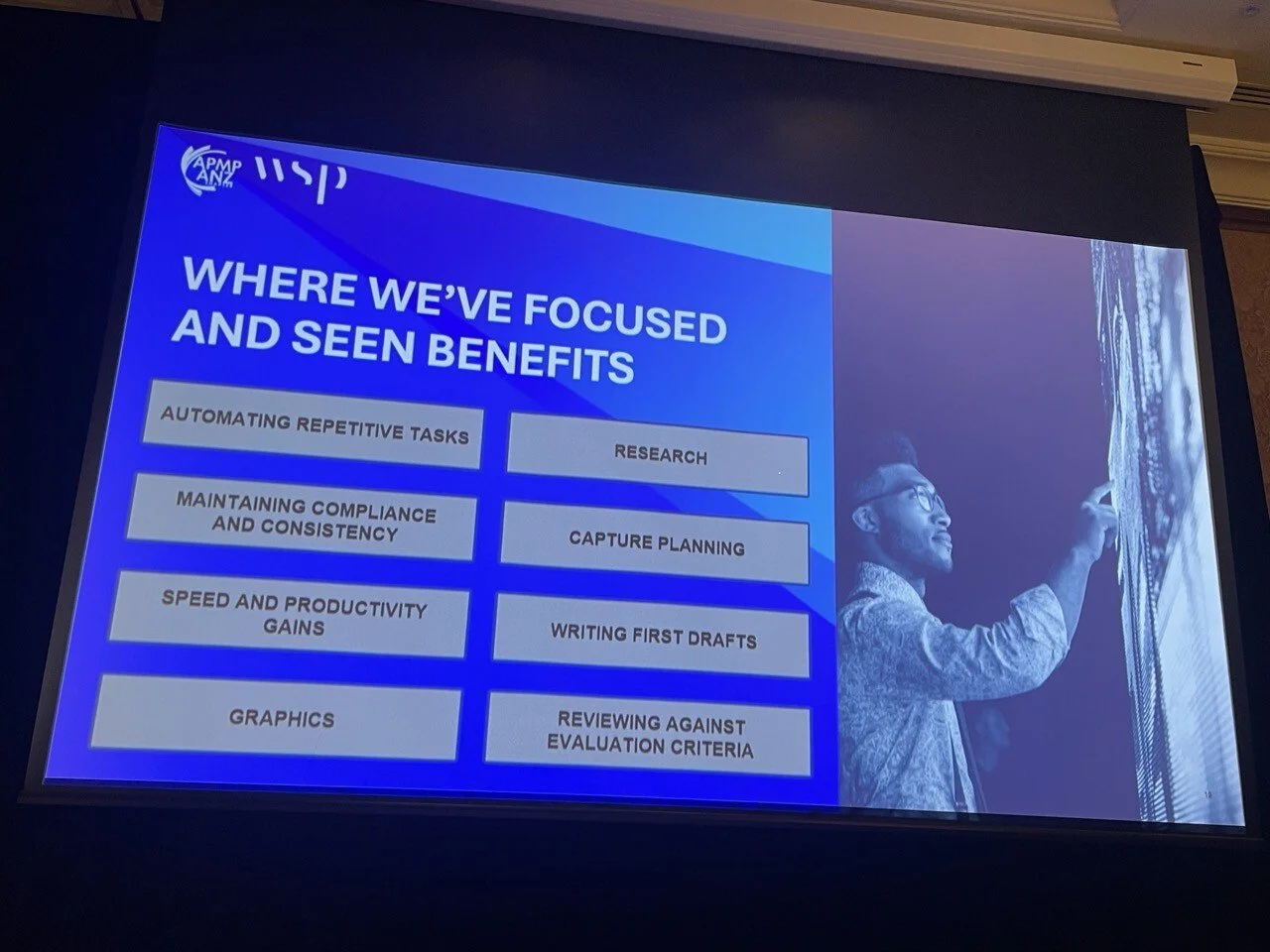
Benefits of using AI in WSP’s work-winning activities
In a later presentation by Charlotte Barnes CPP CL APMP of WSP (‘From fear to fuel: embracing the use of AI in work-winning activities’), there were some really good practical lessons on using AI in the bid process, from tips on prompting (e.g. ‘write this X from the perspective of Y, for the use of Z’), to how governance by human insight is just as important as the technology. To combat Cynthia’s warnings of poor info in = poor info out, Charlotte described how they use and manage their own bid libraries. It took a whole year for them to get them into shape, defining which bids were of high quality (it wasn’t just the winning ones) and good enough for their AI tool ‘COLBY’ to use. Their libraries are based in SharePoint with SMEs checking them every month – I guess this is achievable with a company the size of WSP! I asked Charlotte if there was any quantitative evidence of things improving since they started using AI in their bidding, to which she anticipated a 60% saving of time; the win rate has also gone up, but this can’t be directly attributed to the AI. In my view, I think we are currently in a time where we’re just working out what AI is and its capabilities in work-winning, the next stage might be to have some more accurate data on its usage outcomes; good and bad.
Charlotte admitted AI was struggling with graphics (as did Kate from EY) and I think her point on ‘Moravec’s Paradox’ AI struggles with empathy, persuasion and storytelling, explains why this could be – these are all things instilled in any good bid designer, and really should be part of anyone who’s involved in the sales/bidding process.
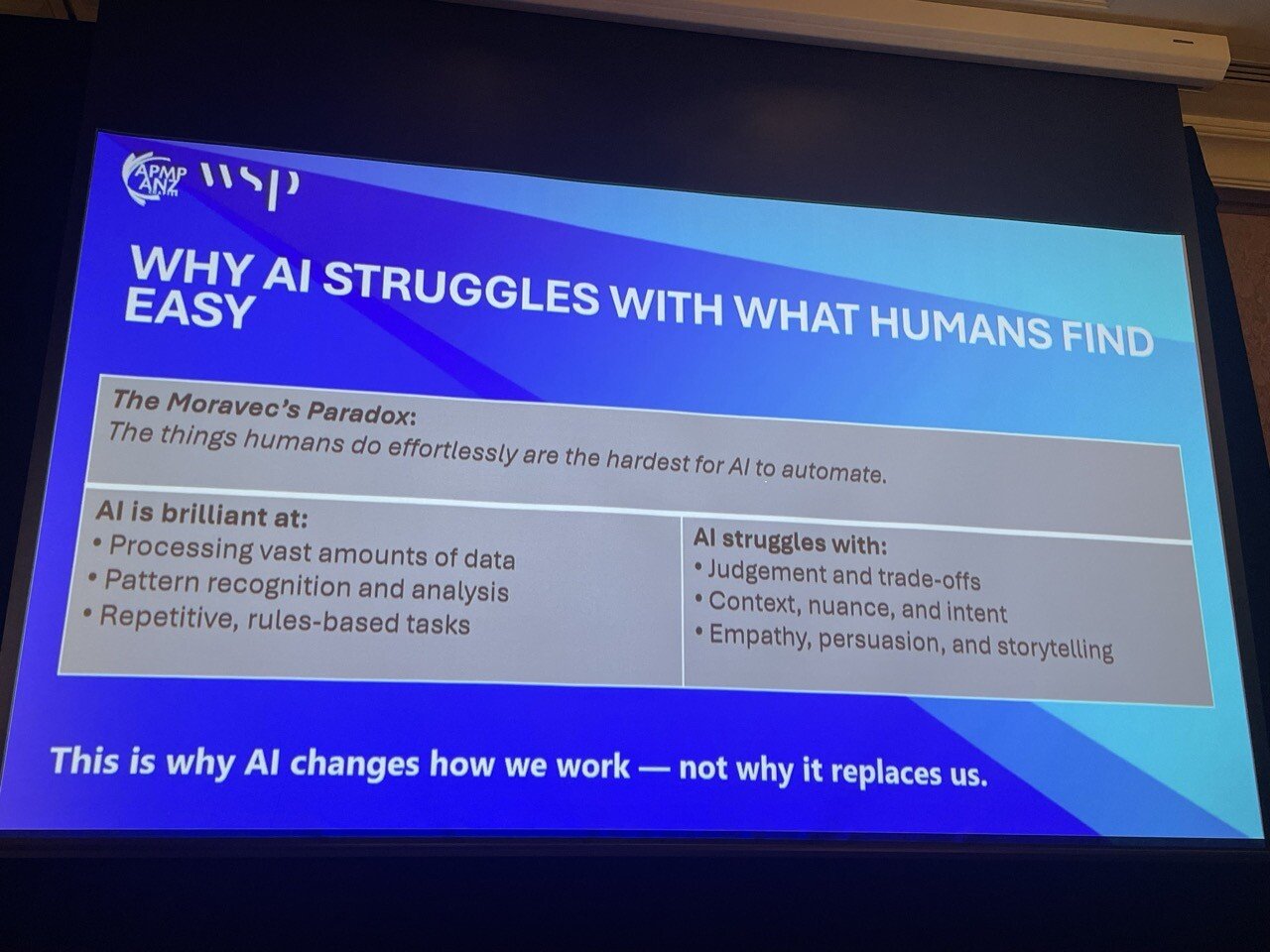
What AI struggles with and what humans find easy
Proposal Humans
“With respect and inclusivity, we can do anything” Uncle John Terrick, Welcome to Country at APMP ANZ, 2026
As already mentioned, we might see AI being used to do a lot of the desktop screening of our tenders, but it comes down to humans to influence decisions by being the ‘trusted advisor’ (Charmaine Keegan), especially in face-to-face presentations and interactives, where mindset, preparation, engagement and language all come into play.
Just as we need to understand how AI works in tenders, we need to understand ourselves as humans too – our limitations and our best bits. I enjoyed Charmaine’s piece on assumptions and how they can really mess things up! When you assume things, you don’t ask questions about it, e.g. when my kids have packed their bags for school, I might ASSUME they packed their lunch too, so I won’t ask them explicitly if they have packed their lunch. I can think of many assumptions people have made in bids of their fellow teammates, e.g. we all know the bid strategy, right? Charmaine also pointed out that the technical people among us can struggle with observing and adapting to others – they think the tools and tech will sell itself (think of a PowerPoint with loads of specifications), rather than thinking of the people aspect. I liked the term of people needing “behavioural flexibility” during this session. However, I worry what will happen when the environment for human interaction is shrinking, and the bid process becomes more of an automated transaction.
Human limitations are something Harry Moffitt understands as a previous member of the SAS and now psychologist – he even featured in the series ‘Limitless with Chris Hemsworth’. Harry provided an emotive presentation on ‘Building strong minds (and teams)’, highlighting a few key things bid teams can learn from. As someone who remembers the term ‘war room’ for some intense bidding activity, I could sympathise with his points on the importance of good sleep to stay focused, and preparing your mental strength before you actually need it. When it comes to a bid team, I really liked his phrase of building yourself a ‘war chest of social capital’ so you can ask for extra help when you need it. I think this could also relate to your home life too, as it’s easy to overlook the impact of bidding on your wider family unit – maybe a treat for the family BEFORE you start the bid?
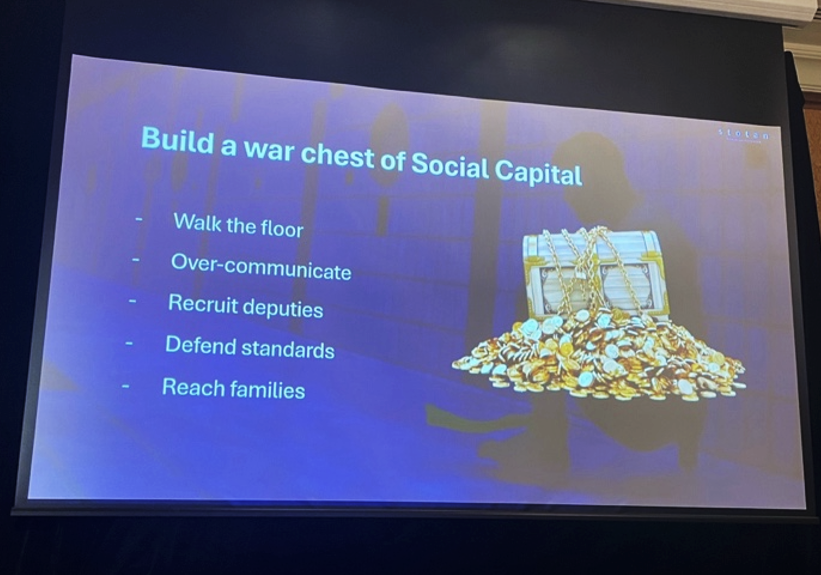
Building a ‘war chest of social capital’
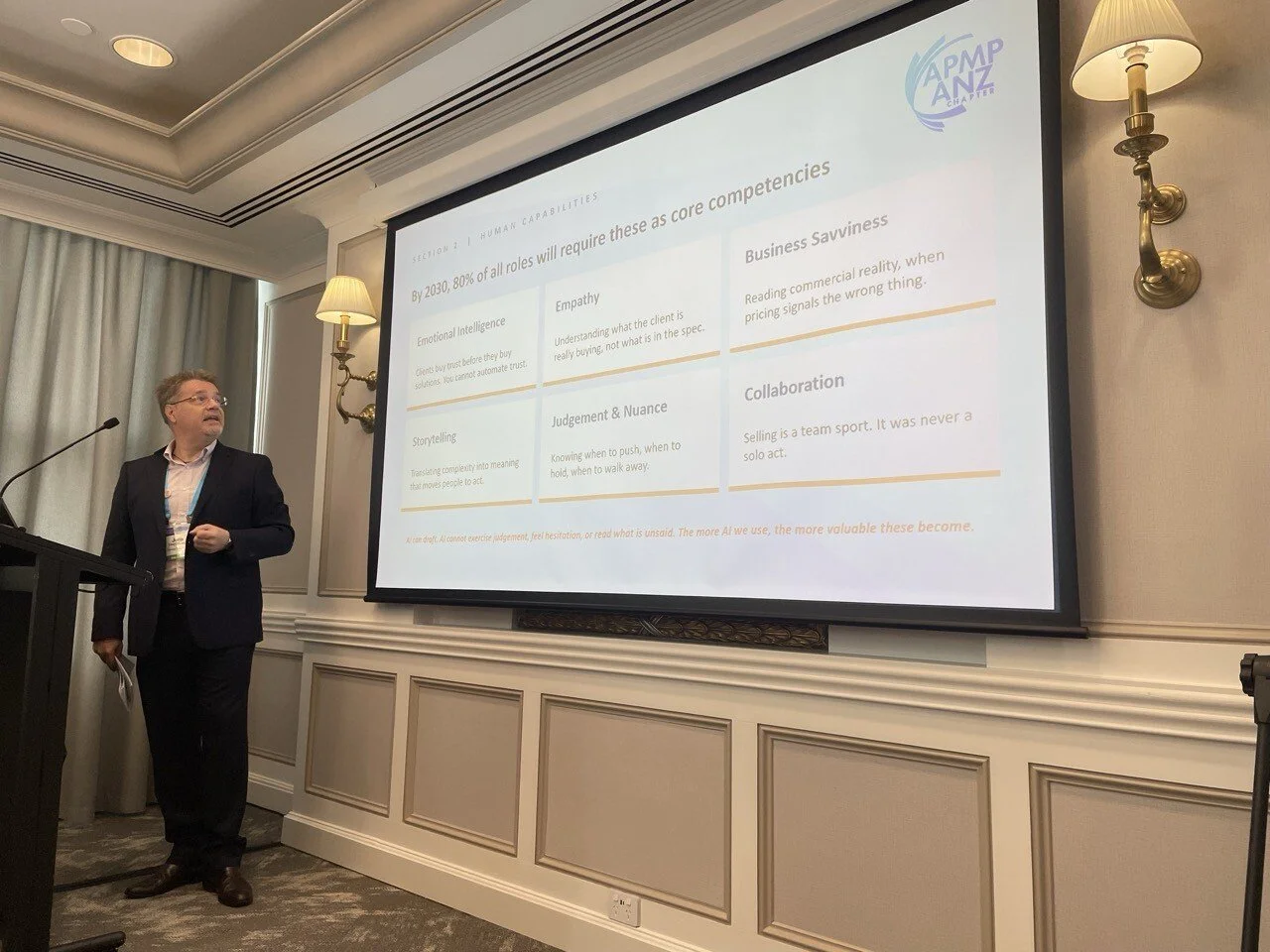
Jens Hartmann (‘Why bid teams belong in the boardroom, not just the back room’) looked at human capabilities, and what core competencies will be required by 2030 when AI is more established in our lives. As a designer, I’d pick out ‘empathy’ and ‘storytelling’ as the key ones for me, especially as Jens agreed there are so many more influencer stakeholders involved in bidding now, all wanting different things, so we need to develop the best ways to communicate with them.
The Future Outlook: AI + Humans = ?
One of my favourite talks was given by Steve Tighe on ‘Making the future work for you’. I could tell it was a good one as I tried explaining it after the event to anyone else who would listen (work colleagues, clients, family members, the dog!). Steve has written a book (see notes at the end), which is now in my reading list, and was a Foresight Manager at Fosters.
“The most likely future, isn’t” Steve Tighe, Chasing Sunrises
He explained how the future that actually happens might be the things we think are ‘ridiculous’ today. That might sound crazy, but if we went back a 10 years and said 18-24 year old men wouldn’t be going to the pub and drinking beer (something they have consistently been doing for hundreds of years) we’d say that was ridiculous; but we only need to look at the increase in zero alcohol, low calorie beer, and the uptake of 5am run clubs instead of 5am nightclubs, to see the ridiculous become reality.
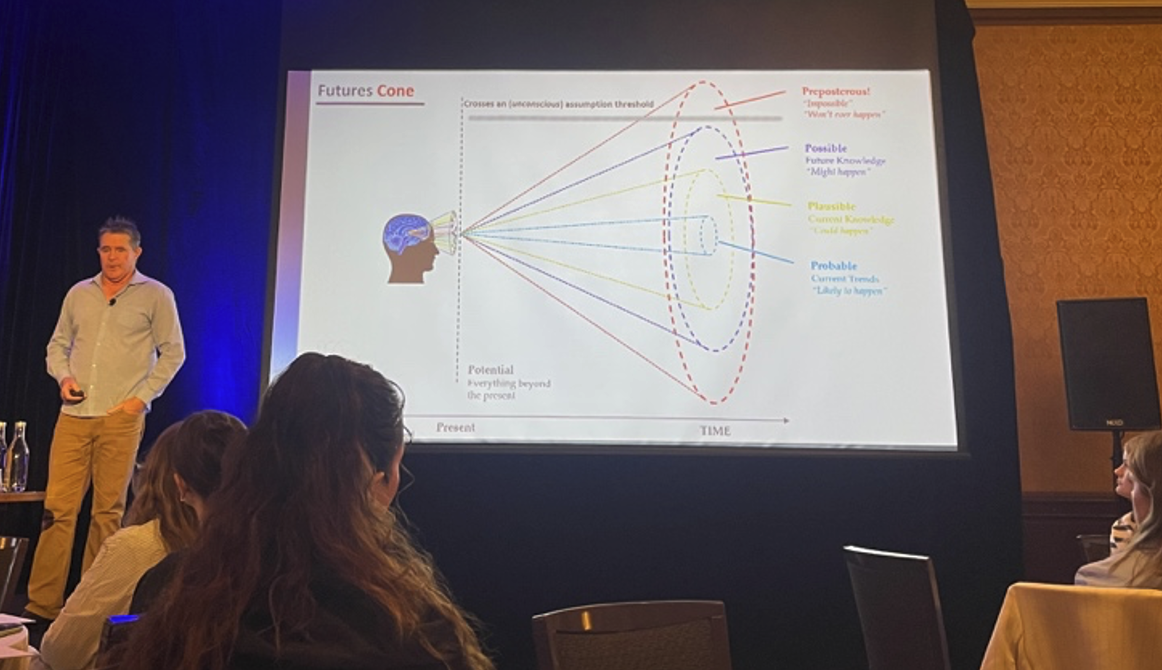
Steve Tighe presents the ‘Future Cone’ diagram
Steve’s introduction to the ‘Futures Cone' (a well-known model in the strategic foresight world) was a good way to think where the future might lead us, from ‘probable’ to ‘preposterous’, but he sadly reminded us that our current macro context of where we do business seems to have some bleak probable futures, with a lot of ‘heightened uncertainty’. Luckily, he gave us some great tips on how to add value and survive this probable future:
Diversify your teams: expanding perception and perspective will provide more ideas out of your comfort zone
Get your house in order: make sure your industry is squeaky clean and you’re not hiding anything. People will find out!
Differentiation is key: understand the price of ABUNDANCE as it makes other things SCARCE and that is where opportunity sits. Think of it like a pendulum – for example abundant AI on the left creating the potential resulting scarcity of other things, such as empthay and trust on the right. It was interesting to compare Steve’s pendulum diagram with all the previous comments on the importance of relationships and trust building required in the bidding process.
Test your assumptions: The assumptions we have link to the actions we take, so do our assumptions match the environment we work in? For example, there was an assumption the Titanic was unsinkable, so the action was to have less lifeboats and travel full speed through icebergs. We can have all the plans in place for the future, but we need to identify the ‘load-bearing’ assumptions that can really mess everything up.
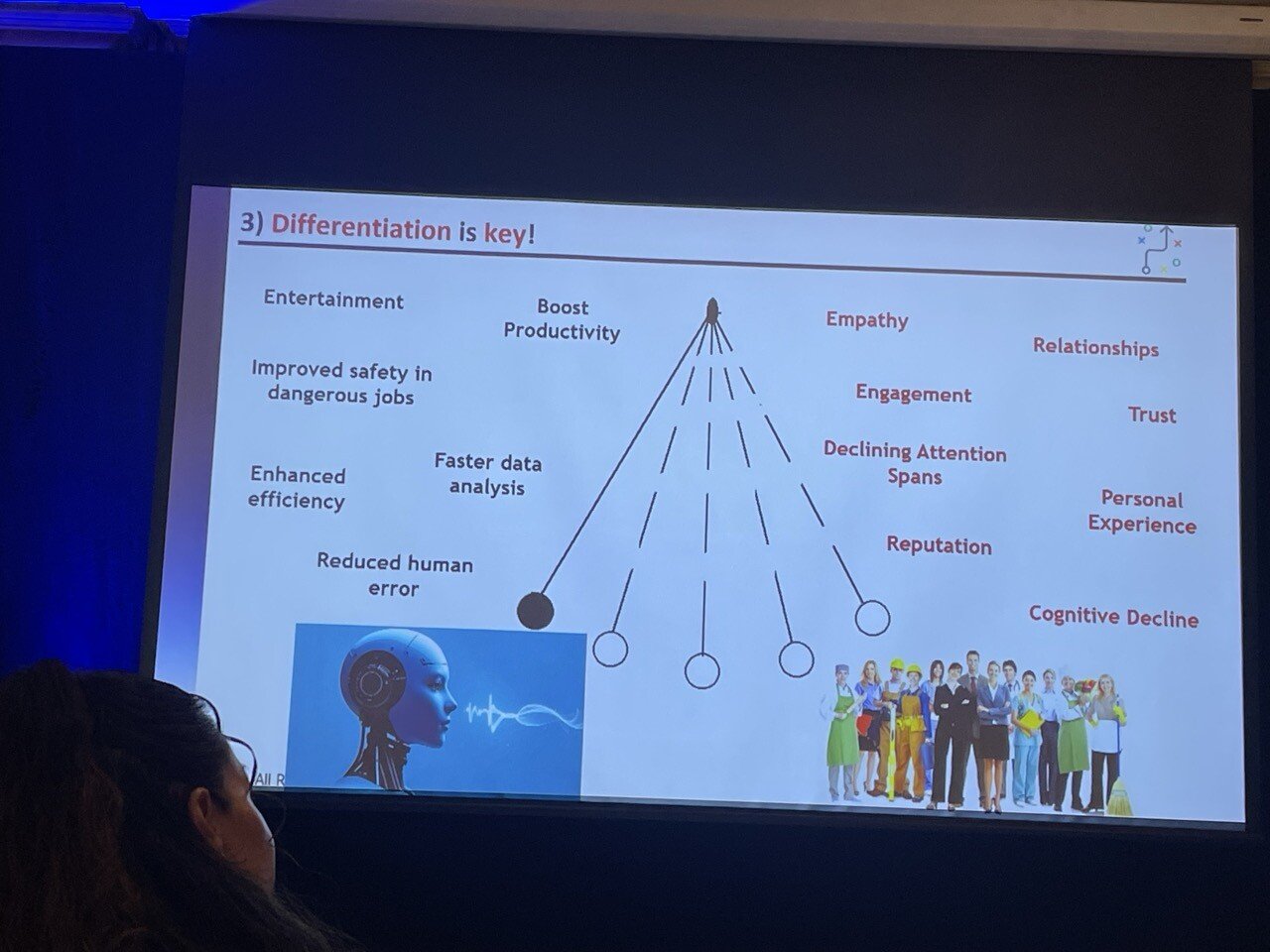
Looking at what becomes scarce as a result of abundant AI
Steve’s talk was right at the start of the conference, but I think I would have put it at the end instead of Nigel Dennis', ‘From craft to co-pilot: insights into the next decade of winning work’. I found Steve’s had a worrying undertone but gave me hope, whereas Nigel’s ended the conference with fear of a bleak future, from a personal and professional perspective! During the presentation, I felt a bit overwhelmed by AI. It was a smack in the face moment where I felt AI was taking over everything and I was being left behind, a future picture of ‘craft’ not being valued, and everything being automated. However, on re-reading the presentation after the event, I found there were some learnings in there. The emphasis of AI being used for tedious but necessary tasks, and a shift from effort no longer equating to value, it’s now all about the outputs.
You could really tell (well, I hope you could!) that this presentation was very heavily ‘designed’ using AI, and I suppose the designer in me just couldn’t see past the AI layouts and cringy imagery (see below).
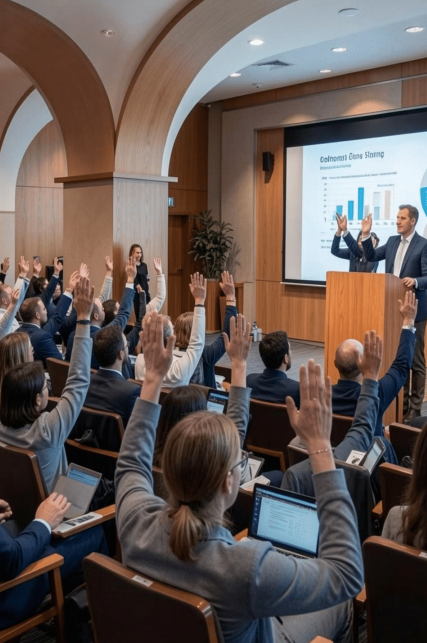
It used to be awkward stock imagery that was cringe, but now it’s AI-generated! Hands all over the place, some with six fingers, and strange typography: tell tail signs of an AI generated image.
I think this last presentation highlighted where we might be with AI at this time. We’ve now got some super-powered tools that can fast-track us to AI generated ‘artefacts’, but there is a risk the quality will drop, and we all start saying “it’s OK, this will do”. If we lose our craft and diminish our hard thinking, how will we know when ‘OK’ just won’t do?
How to be a super-powered proposals human: my practical takeaways
Rehearse presentations to death (content and timing): if you don’t know the material you are less present at the meeting
Think how clear communications can be used to ensure the WHOLE bid team are aligned: reduce the assumptions (even more important with remote bidding).
Use AI to get to a baseline but use our brains to differentiate ourselves and our proposals, standing out from the generic and mediocre.
Don’t just assume certain questions in a tender are box-ticking – research the customer to determine how important certain things are to them, e.g ESG
Push yourself to THINK HARD and challenge things – don’t just rely on AI if you want to stand out.
Think what information the buyer will have on the bidder, even before they receive the tender document. What are those social posts and financial reports looking like?
Make sure you get enough sleep: if it’s the most important thing for the SAS then I think it’s a valid one for proposals teams too!
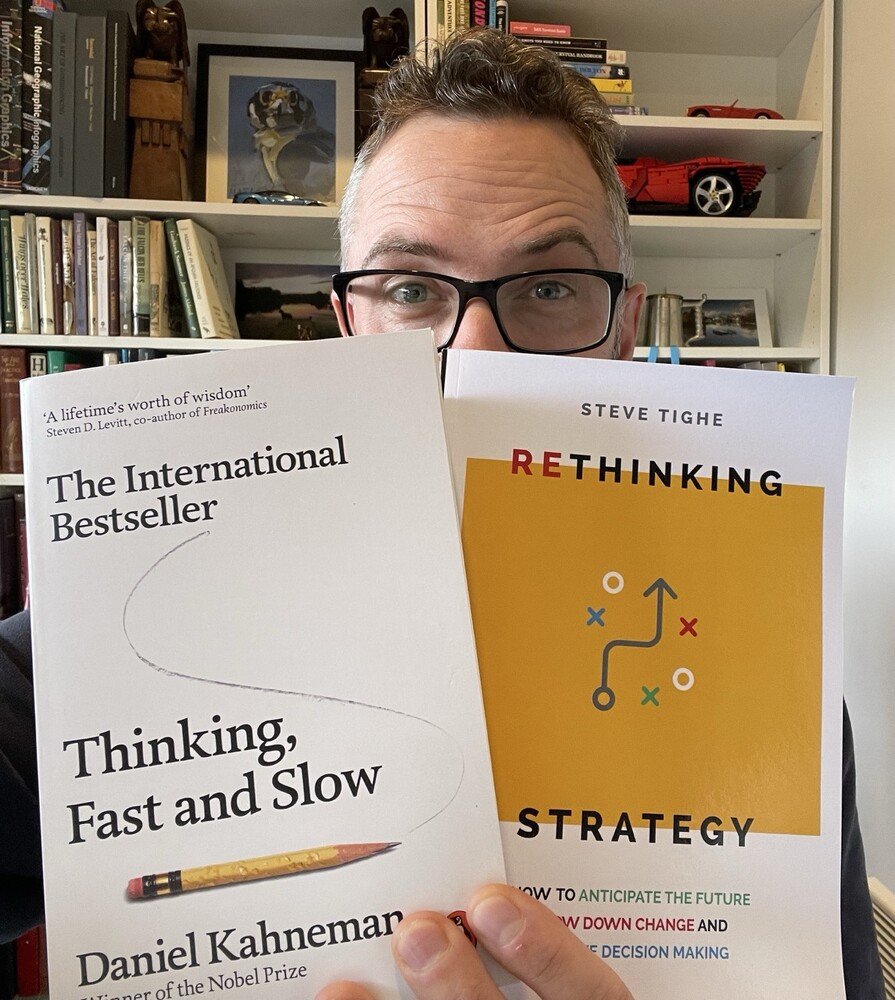
Two books added to my library after attending the conference, thanks to Steve Tighe and Ken Grace for mentioning them.
Thank you
Thanks to the APMP ANZ organisers (especially Tania Field and Samantha MacMillan CP APMP) for putting together a fantastic two days, the presenters for providing thought-provoking insight, and the APMP ANZ members for making me feel so welcome to a new bidding community in Australia. I promise not to wait another 12 years till the next event!
Originally published on LinkedIn.